Have you ever faced the task of rebuilding something from the ground up? In certain ways, it is easier than starting from scratch. Some resources are already available, and if you are lucky, you may be able to obtain advice from your predecessors.
However, in other ways, a rebuild is more difficult than starting new. You have to sort through the remains of something that was once great, but has fallen to pieces.
Last fall, I enjoyed listening to the She Reads Truth episodes about Nehemiah rebuilding the Temple of God after living in exile. Not only did the prophet need to find resources for the new temple, he had to rummage through rubble from the previous temple, and all the physical and emotional challenges that entailed.
How do you “make something great again” after devastations like an exile, or a world-wide pandemic? A few years ago, I took on this very challenge.
In 2021, after releasing my first two music fiction books, The Chronicles of Music Majors, and A Change in Tune, I turned my attention to rebuilding the music program at my children’s parochial school in a post-Covid world. It has been a monumental, yet privileged, task.
At first, students were barely allowed to sing, so even relearning the basic concept of “choir” proved difficult. Since the choral program had been vibrant when I first moved to the area, this was devastating to see the debris of what was once great.
Rebuilding their singing voices, as well as a music culture in students who had been raised online, required creativity and tenacity. My primary drive came from the desire for my own children and their friends to experience music together as past generations had done.
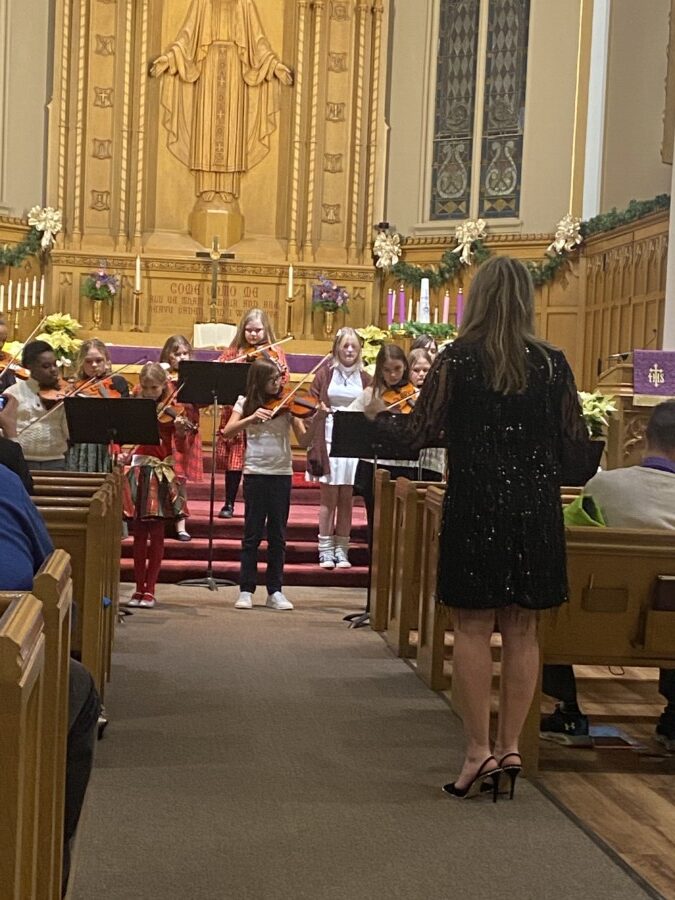
By 2022, I had reduced my private studio teaching load to focus on school music and began a strings program. At first, the lower school program consisted only of my daughter and three of her friends. Recruitment became key in the future success of the program. On a positive note, I had a few Middle School students who already played, having taking private lessons.
By 2023, I had extended the invitation for more students to join orchestra. We needed to overcome obstacles like how to build a strings culture that people would value, obtain student instruments, and learn personal responsibility for bringing the instrument to school.
Once numbers grew, I needed to learn how to work with students of varying ages and levels. For someone with a background in private teaching, this group experience has been a very different challenge.
Fortunately, students have responded well to working with their peers, and often help each other with their music! Over the past couple of years, the orchestra has continued to expand, and I have learned how to differentiate music to meet the different levels of students, while still giving them a group experience.
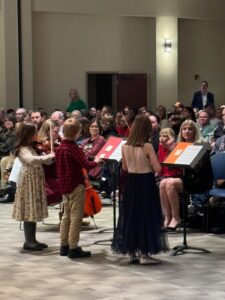
More advanced students also take private lessons and work on solo music, serving as leaders in the ensemble. I have been able to take on a couple of private students again, as well as encourage many students to take from my colleagues in the area. A huge joy was watching my former middle school students from the early group become colleagues last fall, as they performed their first wedding gigs!
Even while rebuilding, I wanted to find time to work on my music fiction writing. Unfortunately, I had very little time or energy to devote to the craft. Teaching is not for the faint of heart!
However, this past year, I felt the writing muse return. I literally thought “I don’t have time for this. I already have so much on my plate!” But the story insisted on coming anyway! God always nudges me when I need to write, and the time had come again.
Fortunately, here in the New Year, I finally had time to write “The End” of my second music fiction novel in The Strings of Sisterhood series. The book is in the editing process, and, God-willing, should be ready for release this Spring.
Stay tuned!